SSADM (Structured Systems Analysis and Design Method)

What is SSADM (Structured Systems Analysis and Design Method)?
SSADM (Structured Systems Analysis and Design Method) is a widely used computer application development method in the United Kingdom, where its use is often specified as a requirement for government computing projects. SSADM is in the public domain and is formally specified in British Standard BS7738.
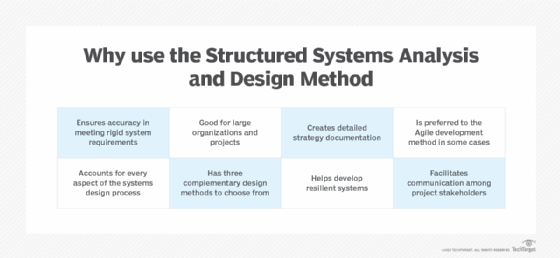
SSADM divides an application development project into modules, stages, steps and tasks. It provides a framework for describing a project in a way that's suited to managing it. SSADM's objectives are to do the following:
- improve project management and control;
- make more effective use of experienced and inexperienced development staff;
- develop better quality systems;
- make projects resilient to the loss of staff;
- enable projects to be supported by computer-based tools such as computer-aided software engineering systems (CASE); and
- establish a framework for good communications among project participants.
Consultants working for Learmonth & Burchett Management Systems developed SSADM v1 in 1981. The methodology covers system lifecycle aspects from the feasibility study to the production of a physical design. It's generally used in conjunction with other methods, such as PRINCE2 (Projects in Controlled Environments), which focuses on broader aspects of project management.
SSADM is applicable to projects with technical and business requirements that are unlikely to change. It uses a top-down waterfall project management approach to information systems projects. SSADM isn't suitable for projects in a volatile business environment, so Agile should be used instead.
SSADM techniques
The following three data modeling techniques are used in SSADM:
1. Logical data modeling. A logical data model depicts the logical data structure of the system and deals with documenting the data requirements of the system. The model describes:
- entities that are objects in the system and have information recorded about them;
- attributes that are descriptors of the entities; and
- relationships that are the associations between the entities.
2. Data flow modeling. Data flows are identified, modeled and documented. Data flow diagrams consist of the following:
- processes that transform data;
- external entities that send data from a system and receive data from another system;
- data stores that hold data at rest; and
- data flows to move data among entities.
3. Entity behavior modeling. This technique focuses on identifying, modeling and documenting the events that occur in the system. It looks at how events affect the entity and the sequence in which they occur.
What are the stages of SSADM?
SSADM uses a cascade or waterfall view of system development, in which a series of steps are followed. This contrasts with the rapid application development method that conducts steps in parallel.
The following steps are part of SSADM.
1. Feasibility stage. A feasibility study investigates the goals and implications of a project to determine whether the project is achievable. The existing system is analyzed for problems that must be solved during development. There are four main areas considered in a feasibility study.
- A technical feasibility study to determine if the project is technically possible.
- Organizational feasibility to evaluate whether the project is compatible with existing systems.
- An ethical feasibility step to establish if the project is socially and ethically acceptable.
- A financial feasibility study to verify if the project is financially practical.
2. Requirements analysis. This step investigates the current environment and examines existing business systems to see what modifications are needed. This includes a cost-benefits analysis of business system options and the potential effect of the new system on the organization and employees.
3. Definition of requirements. The requirements specification for the new system may include a look at the life histories of the entities involved, user role and function matrices, and process identity modeling, data catalogs and correspondence diagrams.
4. Logical system specification. This step consists of two stages:
- Technical system options define possible implementation methods and components, such as staffing costs, the type of software and hardware required, physical limitations of the area that houses the system and requirements for the human-computer interface. At the end of this stage, a technical system option is chosen.
- Logical design defines the logic used in the new system, with a specific focus on human-computer interaction and logical dialog with the system.
5. Physical design. The system's logical specifications are matched to physical architecture. The function and structure of the database component is specified based on outputs from the logical design and technical system option steps.
For each stage, SSADM sets out a series of techniques, procedures and conventions to record and communicate information, both in textual and diagrammatic form. SSADM is supported by numerous CASE tool providers.
SSADM is used today for some large government IT projects primarily in the U.K. Unlike smaller more dynamic software development projects, large public sector projects often require a standard methodology to upgrade legacy systems and manage processes. Learn some business process management best practices to ensure continuous improvement in the enterprise and compare them with the SSADM methodology.